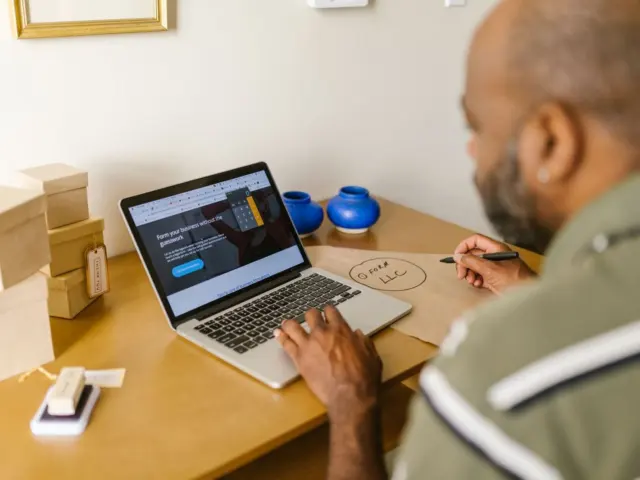

Worried about giving up ownership just to get started? Bootstrapping a small business means funding it yourself, through savings, early sales and sometimes family money, which keeps control but limits speed and cash.
This guide is one part of the wider topic of small business funding, and it looks at self-funding on its own.
| Item | Value |
|---|---|
| Small businesses that use their own funds to start | 78% |
| New businesses started each month | Nearly 500,000 |
| Startups that get angel investment | About 6,000 of those monthly startups |
| Startups that attract venture capital | Fewer than 500 of those monthly startups |
| Businesses receiving SBA-guaranteed bank loans | Fewer than 100,000 per year |
These figures come from a Bplans (LivePlan) guide updated May 13, 2026, which attributes the 78% figure to the U.S. Chamber of Commerce. Figures can change, so check the source before you rely on them.
What bootstrapping a small business involves
In a U.S. Chamber of Commerce CO- article published in June 2021, bootstrapping is described as starting a company with only personal savings, including borrowed or invested funds from family or friends, plus income from initial sales. The same article says self-funded businesses do not rely on investors, crowdfunding or bank loans.
Definitions differ between sources. The Bplans guide notes that some experts still call it bootstrapping when the owner uses loans, as long as they are backed by the owner’s own personal assets, which keeps the entire risk and ownership with the owner.
Check which definition a statistic uses before you compare it with another one. To see how self-funding sits beside the other routes, the overview of types of small business funding is a useful companion.
How common is self-funding?
The Bplans guide, updated May 13, 2026, says the vast majority of new businesses are self-funded. It cites the U.S. Chamber of Commerce for the 78% figure and adds the following numbers for context:
- Nearly 500,000 businesses are started every month.
- Only about 6,000 of those startups get angel investment.
- Fewer than 500 attract venture capital.
- Banks lend SBA-guaranteed loans to fewer than 100,000 businesses per year.

If you want to compare the two outside-investment routes named above, the explainer on angel investors vs venture capital sets them side by side.
Pros of self-funding
The U.S. Chamber’s CO- article, published in June 2021, lists several advantages of bootstrapping:
- Full ownership. Investors take a percentage of ownership in exchange for support, so bootstrapping lets owners keep their share of the equity.
- A model that has to work. The article says most failed businesses struggle due to a poor business model, and bootstrapped owners are pushed to build processes that produce immediate, lasting cash flow.
- Control. Outside money brings external pressure and responsibilities to satisfy investors, while self-funding keeps decisions with the owner.
- A sense of accomplishment. For some entrepreneurs, building something without outside help is its own reward.
Cons and risks
The same article is clear that the approach has drawbacks. Self-funded businesses can run out of funds more quickly and struggle to scale, which can limit a startup’s potential.
- Less support. Traditional financing can bring networking with board members, shareholders and influencers, and bootstrapping limits that.
- More organisation. Owners must keep their books meticulously in order.
- More work. With limited resources and connections, owners take on more roles.
The Bplans guide adds that when you self-fund with personal finances, finding out too late that there is no market fit means losing cash from your own pocket. Terms, costs and options vary by provider and country, so treat any single source as a starting point.
Steps in a bootstrapped start
The Bplans guide, updated May 13, 2026, sets out a sequence for owners who want to stay self-funded. Its steps include:
- Understand your startup capital needs. Some business types, such as those needing equipment, inventory or rent, are harder to start with nothing. The guide suggests service-based or online businesses, or a slower side-hustle start, as alternatives.
- Create a business plan. The guide recommends a one-page plan focused on the financial plan, marketing plan and sales channels, with close attention to cash flow.
- Identify resources. Decide whether you will use your own equipment and cash, rent out assets or services, or build up cash before pursuing growth.
- Test your idea early. A lack of market fit can sink a business early, and it costs more when the money is your own.
The guide says a bootstrapped company functions very similarly to a funded one. The main differences are that the owner typically does more alone, leans on as many existing resources as possible, and may grow at a slower rate.
On capital, the guide suggests that owners with a business that needs a high upfront spend can invest personal funds or connect with a partner to help with those first purchases. Owners set on a business that needs extensive funding can approach it slowly as a side hustle, which lets them scale and invest at a pace that does not require outside investment.
On planning, the guide says you need to understand your business numbers, specifically cash flow, from the start, and have a plan to generate revenue. That gives you an idea of how long it may take to become profitable, how much cash you have and are using, and how risky specific decisions may be. Revisiting that plan regularly, rather than writing it once, is how the guide frames its use for a bootstrapped owner.
Its key strategies also include contributing personal assets, taking on personal debt, forming strategic partnerships, and limiting initial operations to control costs and reinvest profits for growth. Personal debt carries its own risk, so weigh it carefully against the other options.
Bootstrapped companies as examples
The U.S. Chamber’s CO- article from June 2021 names several businesses it describes as bootstrapped. The figures below are as reported then and may have changed since.
- BiggerPockets: launched without any venture capital money.
- Mailchimp: described as driving nearly $700 million in annual revenue and still 100% founder-owned.
- MyClean: its founders convinced friends and family to loan them $267,000, and the article reports more than $9 million in annual revenue.
- SparkFun Electronics: annual revenue over $30 million.
- Tough Mudder: its founders each put about $10,000 into the company.
These are selected success stories, so they do not show what a typical outcome looks like.
Frequently asked questions
Does bootstrapping mean using no borrowed money?
Show answer
Not always. The U.S. Chamber’s June 2021 article counts money borrowed from family or friends but excludes bank loans, while the Bplans guide says some experts accept loans backed by the owner’s personal assets.
Do bootstrapped founders keep full ownership?
Show answer
According to the U.S. Chamber’s June 2021 article, bootstrapping lets owners retain their share of the equity, because investors take a percentage of ownership in exchange for their support.
Is bootstrapping risky?
Show answer
The same article says self-funded businesses can run out of funds more quickly and struggle to scale. The Bplans guide notes that when the owner’s personal finances are in use, mistakes cost the owner directly.
Which businesses are harder to bootstrap?
Show answer
The Bplans guide, updated May 13, 2026, says businesses with a high upfront investment for equipment, inventory, rent or other initial expenses are harder to start with nothing.
This article is for general information and education only and is not financial, investment, tax or legal advice.